What Coin Check looks at
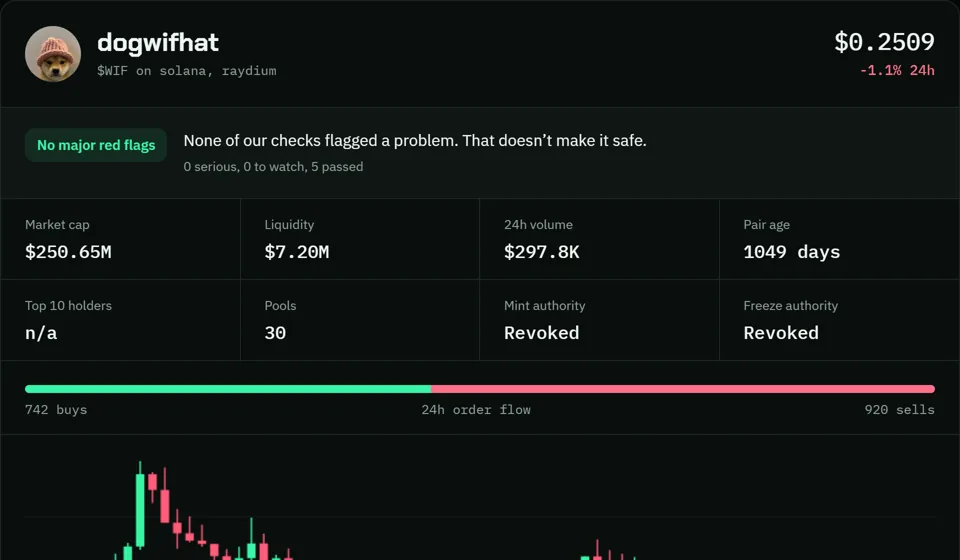
Rugs tend to repeat the same few tricks, and most of them show up in public data if you know where to look. Coin Check pulls the numbers a careful trader would check by hand and puts them on one screen.
Liquidity
Liquidity is the money sitting in the trading pool, the thing you sell into. With a few thousand dollars of liquidity, even a small sale moves the price sharply, and a large holder can drain it. We flag pools under $10,000 in red and under $50,000 in amber. Read more in what liquidity means and why it matters.
Pair age
A pair that started trading a few hours ago has no track record. Many rug pulls happen in the first day or two, so we flag pairs younger than 24 hours in red and younger than a week in amber.
Mint and freeze authority (Solana)
If the mint authority is still active, someone can create new tokens at will and dilute every holder. If the freeze authority is active, someone can freeze token accounts, which can stop people selling. Both are normal during a launch and are usually revoked afterwards. If they are still live on a token that's trading, that's a red flag.
Holder concentration
We add up how much of the supply the 10 largest accounts hold. A high number means a few wallets can move the price. Note that the largest accounts often include the liquidity pool itself and exchange wallets, so treat this as a prompt to look closer, not a verdict.
Trading patterns
Lots of buys and zero sells over a day can mean selling is blocked (a "honeypot"). Volume many times larger than the pool can be genuine hype or wash trading. A huge 24-hour move cuts both ways. We point these out so you can dig in.
Links and socials
We show whether a website or social channels are listed on DexScreener. Having them proves nothing, and scammers make convincing sites, but a token with no public presence at all deserves extra caution.
For a step-by-step routine, read how to check a memecoin before you buy and spotting a rug: 7 red flags.
Questions
Where does the data come from?
Market data comes from DexScreener (pairs, liquidity, volume, links) and GeckoTerminal (hourly candles, which we draw ourselves). For Solana tokens we also read the token's mint account and largest holders straight from the Solana blockchain. Reports are cached for 60 seconds.
Does a clean report mean a token is safe?
No. Coin Check catches common warning signs. It can't see a team's intentions, off-chain promises, or a contract trick it doesn't test for. Use it as a first filter, then do your own research.
Do you store what I check?
We keep an anonymous count of how many checks run so we can see if the tool is useful. We don't store your IP address with the token you looked up, and there's no account or wallet connection.
Why can't I find my token?
Coin Check needs a trading pair listed on DexScreener. Brand-new tokens on bonding curves may not have one yet.